
Clean
Water Plant
- Report an Emergency
- The Clean Water Plant
- Biosolids
- Stormwater
- What Can I Do?
- IPP (Industrial Pre-Treatment Program)
- Awards
REPORT AN EMERGENCY
Weekdays (7 am – 3:30 pm)
616‑772‑0873
Nights/Weekends/Holidays
616‑772‑2001
HOURS
Monday–Friday: 7:00 AM–3:00 PM
LOCATION
Plant Location: 350 E. Rich Avenue, Zeeland, MI 49464
Billing Address: 21 S. Elm Street, Zeeland, MI 49464
The Clean Water Plant
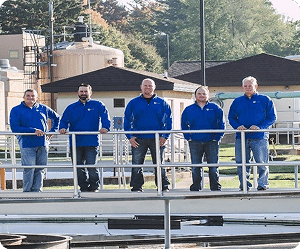
Why is Wastewater Treatment Necessary?
Wastewater contains large amounts of excess nutrients such as phosphorous and nitrogen that could overwhelm the watershed if they were directly discharged into the Noordeloos Creek. The Zeeland CWP “cleans” the wastewater to remove those excess nutrients. Clean water meeting National EPA standards is returned to the creek and the captured nutrients are processed and recycled in a controlled application as agricultural fertilizer.
The Clean Water Plant
The Zeeland Clean Water Plant uses a Biological Nutrient Removal (BNR) process in our activated sludge plant to remove phosphorous and nitrogen from the wastewater before it is discharged into the Noordeloos Creek. The plant treats an average of 2.1 million gallons a day (MGD). This means micro-organisms are used to remove the waste products in the water using very little, if any chemicals at times.
The plant is staffed 365 days a year to make sure the community’s wastewater is cleaned. Plant operations are carefully monitored and controlled using state of the art process technology to ensure utility efficiency, while maintaining State and Federal compliance standards that provide the highest quality of water discharged from the plant to the Noordeloos Creek. We use ultraviolet disinfection technology to ensure the public can safely use the lakes and streams the plant discharges to.
Primary Treatment
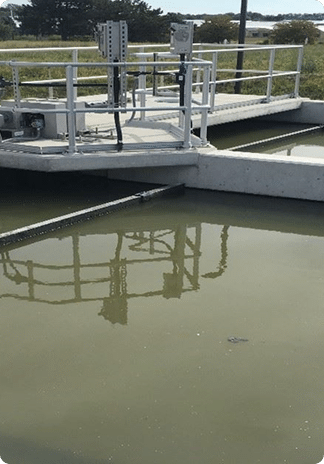 Velocity of the flow is slowed using five large primary tanks to allow heavier organic materials to settle out of the water. These solids contain excess nutrients such as nitrogen and phosphorous. The primary effluent then flows by gravity into one of the two Aeration trains for Biological Nutrient Removal (BNR) process. The solids that have settled are digested in an Aerobic Digestor which are part of our biosolids reduction process. The water now is slightly cleaner, though it still has dissolved nutrients and minimal solids that still need to be removed.
Secondary Treatment
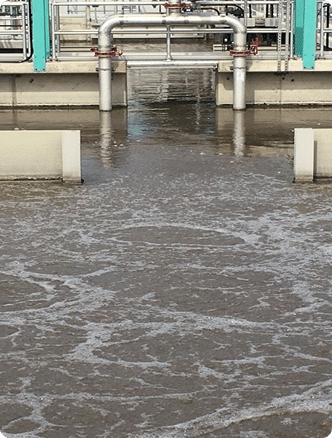
The secondary process utilizes a Biological Nutrient Removal (BNR) treatment system. Large volumes of microscopic organisms are kept suspended in tanks using diffused air bubbles (like you would see in an aquarium). These microbes are normally present in nature and thrive on the dissolved nutrients. Secondary treatment is concentrating this natural process to remove excess nutrients such as phosphorous and nitrogen from the water.
Water Treatment Process
- Wastewater flows by gravity and nine lift stations to the plant by a system of underground trunk sanitary sewers in the City of Zeeland, Zeeland Township and parts of Holland Township.
- Screening structures remove inorganic materials from the water.
- Grit (inorganic sand and gravel material) is removed by a vortex grit removal system.
- The sewage then flows by gravity into the primary treatment.
 Disinfection and Discharge
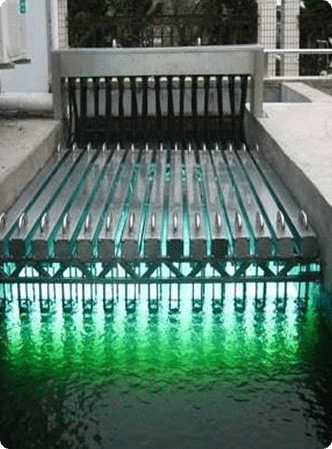
Because of the concentrated human use of the water it needs to be disinfected before being returned to the watershed. This is accomplished by exposing the flow to Ultraviolet Light, which removes pathogenic organisms and treats the water to meet body contact standards.
The final step is a cascade aeration system (like a waterfall). This restores oxygen to the water before it is finally returned to the watershed.
Final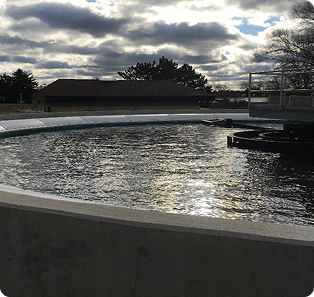
The flow now goes into circular settling tanks. All of the microbes that consumed the nutrients settle to the bottom and are returned either to the secondary process or the solids handling process. Clean, clear water flows out of these tanks over weirs and into the last stages of treatment.
Biosolids
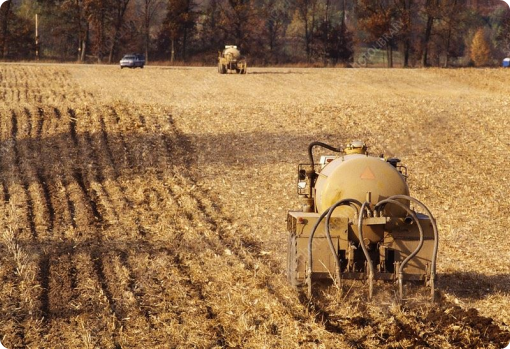
Biosolids are generated throughout the treatment process. The Zeeland CWP utilizes two Aerobic digestors to reduce the solids biologically, then sending the digested solids to a Sieve Drum concentrator to thicken sludge suitable for land application. The stabilized solids are then stored in six tanks equaling 1.6 MG, where Nutrigo Environmental Services removes the nutrient rich solids periodically and injects them into farmer’s fields, the Zeeland CWP’s regulated residual management plan is closely monitored by the State of Michigan Environment/Great Lakes and Energy (EGLE).
Farmers and Growers
The City of Zeeland has a robust Bio-Solids Management Plant, biosolids are tested by an independent lab and analytical results must meet stringent parameters that are submitted to the State of Michigan EGLE prior to land application. The program has proven that bio-solids are a valuable resource when recycled to farm land and could meet much of your fertilizer needs. If you are interested in the City’s program or would like more information, please call (616) 772-0873 or email on the of the contacts listed on this page.
Stormwater Management
What is Stormwater Runoff?
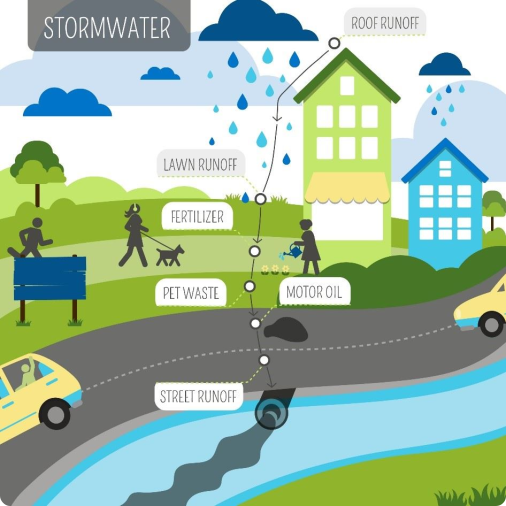
Stormwater Runoff is rainfall that flows over the ground surface. It is created when rain falls on roads, driveways, parking lots, rooftops and other paved surfaces that do not allow water to soak into the ground. Stormwater Runoff is a leading source of water pollution and excess surface runoff to streams.
Where Does Stormwater Runoff Go?
When stormwater cannot sink into the ground, it has nowhere to go but to flow across the surface of the ground. Most stormwater runoff flows either: directly into streams, rivers, ponds, lakes and wetlands or down the nearest storm drain and then into the nearest waterway without any treatment.
What’s the Difference Between Storm Drains and Sanitary Sewers?
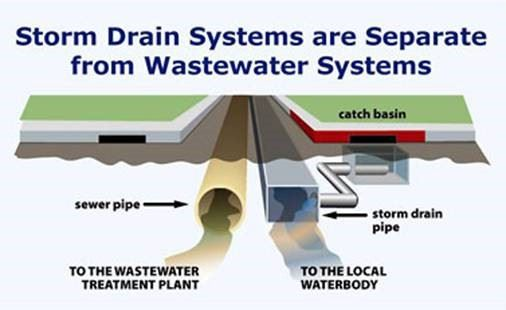
City storm drains are separate from sanitary sewers and do not drain into municipal wastewater treatment facilities but carry stormwater runoff from a catch basin (a.k.a., storm drain inlet, curb inlet) into streams, rivers, ponds, lakes and wetlands.
The sanitary sewer is a system of underground pipes that carries sewage from bathrooms, sinks, kitchens, and other plumbing components to the wastewater treatment plant where it is filtered, treated and discharged.
How Can Stormwater Runoff Be Reduced or Prevented?
To counteract these impacts of stormwater runoff, the City of Zeeland has adopted a stormwater pollution prevention program to manage stormwater for all new development. Stormwater management is the use of specific practices, constructed or natural, to reduce, temporarily detain, slow down and/or remove pollutants from stormwater runoff.
Stormwater Pollution Prevention
The City of Zeeland is issued a Storm Water discharge permit. The State of Michigan EGLE requires the City of Zeeland to monitor and maintain our storm water drains and pipes that transport stormwater and sample during high rain events to ensure water is free from pollutants that could harm the environment. The City of Zeeland works in collaboration with the Macatawa Area Coordinating Council (MACC) to meet our storm water requirements, while also reducing phosphorus levels that have been identified as one of the pollutants causing problems in Lake Macatawa. The MACC has a website containing a newsletter and showing projects that have been completed in the Lake Macatawa watershed.
For more information about the Macatawa Area Coordinating Council (MACC) and other ways that you can help make a difference contact the links below:
What Can I Do?
Environmental health affects us all. Actions that we think are small can add up to big benefits. Lean more about what you can do to improve our environment.
Tours
The City of Zeeland is very proud of our Clean Water Plant, we love the opportunity to show off the well-maintained facilities and educate the community about the highly technical, biological nutrient removal process, along with the equipment that is used to clean wastewater. Group tours of the plant are available and can be scheduled Monday through Friday from 8:30 AM to 1:30 PM, but may be limited by weather, plant construction, staffing requirements or operational conditions.
Tours Guidelines
- Please allow 2 weeks’ prior notice for scheduling.
- Typical power point presentation and walking tour lasts approximately 1 hour.
- Most areas are outside so please dress weather appropriate.
- Desired group size would be approximately 20 persons or fewer, we can try to accommodate larger groups.
- Ages younger than sixth grade level are not recommended.
- Notify plant personnel of any special accommodations needs at the time of scheduling.
For more information regarding plant tours, please call (616) 772-0873 or zwwtp@cityofzeeland.com
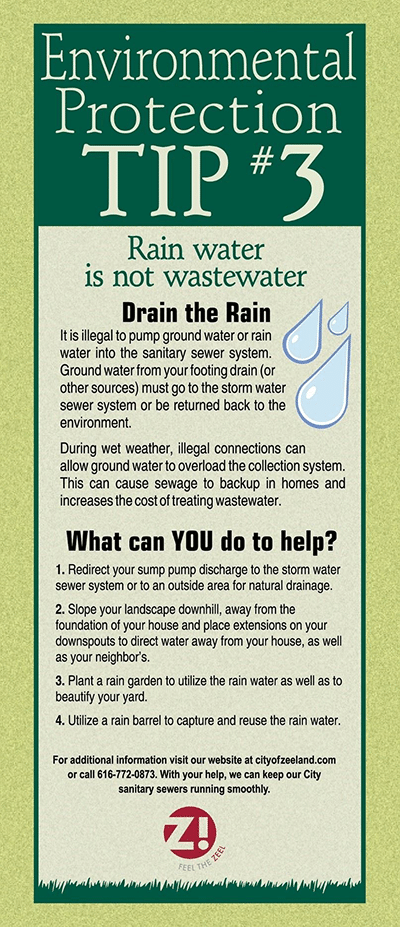
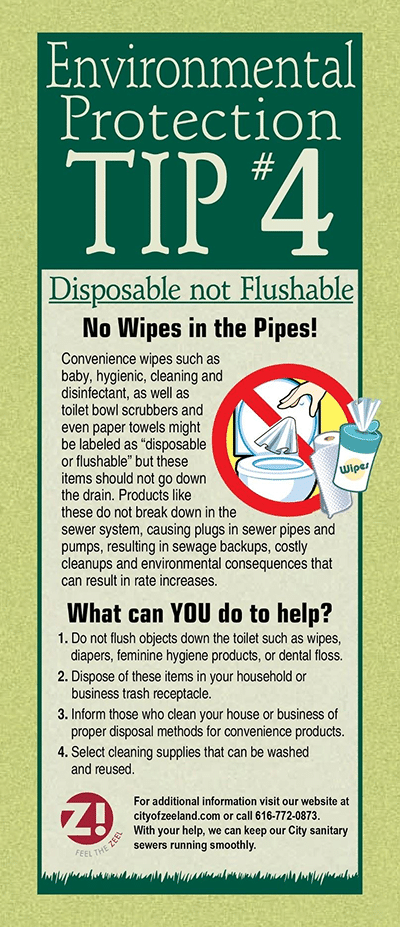
Environmental Tips


Industrial Pre-Treatment Program (IPP)
The City of Zeeland CWP administers an Industrial Pre-treatment Program designed to ensure that the community, the wastewater plant, and the environment are protected. This program is required by the Environmental Protection Agency (EPA) and the State of Michigan Environment, Great Lakes and Energy (EGLE).
The program periodically issues permits to non-domestic sewer users within the collection system as needed to ensure that the concentrations of any pollutants in their wastewater comply with the requirements of the Sewer Use Ordinance. Samples of wastewater are also collected from various points in the collection system to continuously monitor for unknown sources of pollutants. In the event of an accidental spill or discharge, the program will utilize available resources in attempt to ensure regulatory compliance.
Detailed information regarding the wastewater discharge limits, rates, and penalties can be found in our Guide to the Sewer Use Ordinance document of Chapter 86 of the Code of Ordinances.
Code of Ordinances-City of Zeeland Sewer Ordinances
Baseline Monitoring Survey (BMS) Non-Domestic Users
Baseline Monitoring Report/Wastewater Discharge Disclosure Report (BMR/WWDDR)
Semi-Annual Compliance Report-January through June
Semi-Annual Compliance Report-July through December
Non-Domestic User Survey-Permit Renewal
Submit A One-Time Dental Discharge Report
Do you run a dental facility located in the City of Zeeland, Zeeland Township or Holland Township? You are required to submit a one-time compliance report for dental dischargers.
Download and complete the compliance report, the form contains the minimum information dental facilities must submit in a one-time compliance report. This report is required by the effluent limitations’ guidelines and standards for the dental office category (“Dental amalgam rule”).
City of Zeeland Industrial Pretreatment Program-One-Time Compliance Report for Dental Dischargers
Keep a copy of the completed form and return it to:
City of Zeeland CWP, attention IPP Department
21 South Elm Street
Zeeland, MI 49464
Awards
The Clean Water Plant has received recognition for its reliable operations and commitment to protecting the environment. These awards reflect the dedication of our staff and the community’s investment in safe, sustainable water management.
Awards Received
- 1985 – The plant received an EPA Region Five First Place Award of Excellence for “Outstanding Operation and maintenance of the Pollution Control Facility” (medium advanced plant category). Region Five includes Michigan , Indiana , Ohio , Illinois , Wisconsin and Minnesota .
- 2000 – The plant received an EPA Region Five First Place Award of Excellence for “Outstanding Operation and Maintenance of the Pollution Control Facility” (medium advanced plant category).
- 2000 – The plant received an EPA National Second Place Award of Excellence for “Outstanding Operation and Maintenance of the Pollution Control Facility” (medium advanced plant category).
- 2000 – A special tribute from the State Of Michigan .
- 2000 – A special tribute from the County of Ottawa, Michigan.
- Zeeland Environmental Action Leadership (ZEAL) Award of Merit from the Zeeland Chamber of Commerce.
- 2001 – A certificate of Leadership from the Michigan Water Environment Association.
- 2015 – Certificate of Appreciation from the Michigan Department of Environmental Quality Water Resources Division for 30 years of participation in the Industrial Pretreatment Program.
Contact us
Doug Engelsman
Clean Water Plant Superintendent