
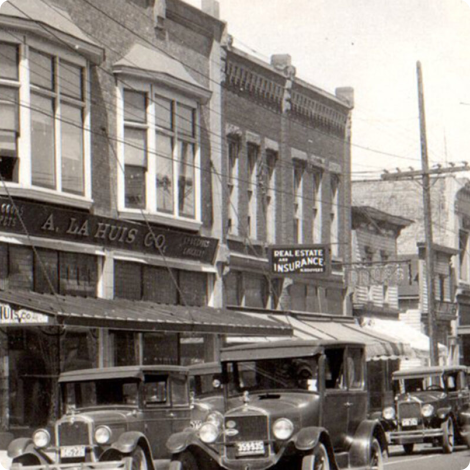
History of
Zeeland
Dekker Huis Museum & Zeeland Historical Society
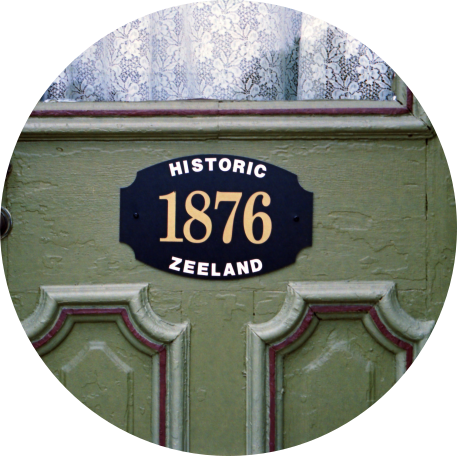
The Dekker Huis Museum, operated by the Zeeland Historical Society, curates thoughtful exhibits that help visitors learn about Zeeland and it’s surrounding communities’ past so we can create a better future together. Housed in the historic 1876 Dekker family home, the museum includes gallery spaces, a barn, and an interurban station with a collection of over 20,000 artifacts.

A History of Zeeland
- Settlement
- Business Beginnings
- Church & School
- Connecting Communities
- Fires of 1871
- Roads
- Transportation
- Zeeland Hotel
Settlement
Settling In
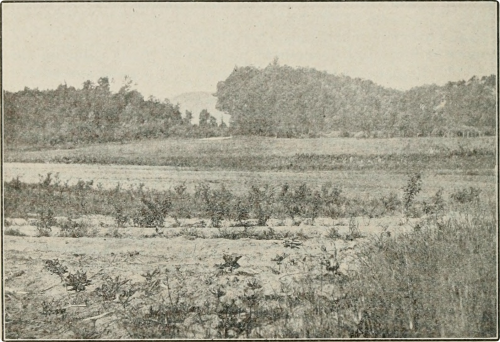
For Jannes Vande Luyster the expending of both his life and his assets to the settlement of Zeeland in 1847 was simply the overflow of his generous heart and willing hands. Selling all his physical assets in the Netherlands, Vande Luyster provided passage for those lacking the means.
Upon arrival, he was also well equipped to select and purchase land and extend credit to those in need. The familiarity of the Vande Luyster name and the recollection of his vision and efforts, however, has often overshadowed the Ottawa Native Americans–a present and prominent source of aid to the Zeeland immigrants
Cabins
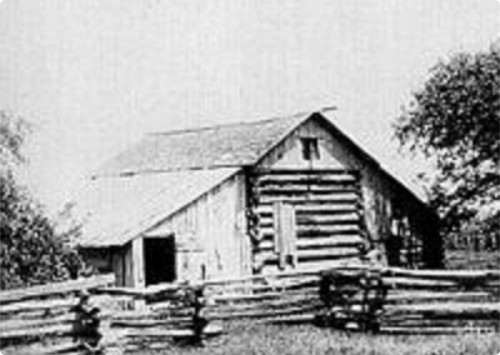
The early months for the Zeelanders held poverty, disease, and a scarcity of food. By the fall of 1847, however, their perseverance in the midst of these hardships resulted in the clearing of forest land for both the planting of crops and the building of 120 log homes. This job of clearing the dense forest was an all-consuming task, demanding weeks and months of daily effort as their tools were few and manual labor exhausting. Once cleared, the building of their homes could begin.
Construction of these log homes consisted of a general plan. Most were about 18 x 20 feet in size, with the use of split logs for flooring. A table, chairs, bedstead and fireplace completed the interior of these one-room homes.
Help from Natives
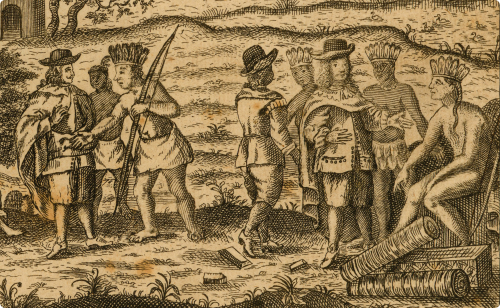
Friendly, peaceful and helpful, the Indians taught the first Zeeland settlers the skills of wilderness living; the snaring and hunting of wild game and, in particular, the unaccustomed work of felling trees, for “the land was a majestic wilderness – an unbroken forest of tall pine, monster oaks and cedars, with Zeeland in the depths of this forest.” (Zeeland Record, 1934)
The early immigrants, therefore, found their hardship lessened and their success advanced through the methods which the Native Americans taught for survival in such a harsh environment.
Business Beginnings
Early Businesses
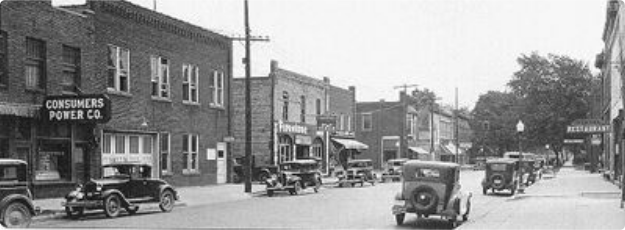
Only a few months after the arrival of the settlers from the Netherlands, the first business was established. Johannes Hoogesteger provided the first general store. Supplies for this store were brought by flatboat from Grand Rapids down the Grand River. Though short-lived, this store stood as the first enterprise in Zeeland.
Zeeland Brick Company
The yards of the Zeeland Brick Company were started in 1848 by M.J. Veneklasen. The brick-making industry was an important enterprise in the early colonial days and, though its beginnings were small, it soon grew into the largest industry of its kind within the state.
Saloons
Prior to the 1900’s, Zeeland harbored saloons in its business district. Around the turn of the century the citizens of Zeeland voted in favor of a “no liquor” law determining that Zeeland would be “dry.” The early Dutch settlers, though not so strict about drinking, did appear to hold reservations regarding movies, for the city of Zeeland has never in its history given license to house a movie theater.
Closed for Business on Sundays
In keeping with their respect for traditional Sunday observance, Zeeland merchants closed their doors to business on the first day of the week. The local custom of drawing the shades over the store windows were a reflection of the merchant’s desire to limit the temptation of the citizens to window-shop or covet some item on display.
Friday Concerts
Friday nights often found the townspeople dressed in their best to attend an hour and a half concert in the northwest park on the corner of Church and Central Avenue where a band stand was erected.
Business Leader Vande Luyster
As a business leader of the Zeeland Colony, Vande Luyster purchased 1680 acres of land from the United States government, choosing the site where Zeeland is now located. Eighty acres were set aside in the center as the village, four-and-a-half acres were designated for a church, school, market place and cemetery. His diary records the naming of the village Zeeland “because it was founded by Zeelanders, who called upon the name of the Lord to prosper His work and that His name might be called upon there forever.”
Church & School

First Church & School
Having occupied their own houses, the next priority for the Zeeland settlers was the building of a school and a place for worship. Within the first year a colonial church was constructed out of round cedar logs.
The First Pastor
The Reverend Cornelius VanderMeulen accepted the invitation to become the first spiritual leader and pastor to the Zeeland Colonists, offering both hope and courage for the first twelve long and strenuous years in their new land. In the early months, until the church building was completed, the Rev. VanderMeulen could be found preaching each Sunday in his home, in various other homes or out of doors. The church soon became the social life of the colony; the encouraging sermons of their pastor renewing their spirits and enabling them to continue enduring the hard struggles and numerous difficulties of pioneer life.
Schooling
Once completed, the church served as a place of worship on Sunday and as a school on weekdays. School instruction was provided in both English and Dutch. The subjects taught were mostly limited to reading and math, though religious education was of great importance to both the pioneers and their pastor. Because there were no laws requiring school attendance, the boys’ school days were often regulated by the planting and harvesting seasons and the girls’ attendance depended upon the needs of the mothers and younger children.
Connecting Communities
Drenth, MI
First to Arrive
The first to arrive in the locality of present Drenthe was Jan Hulst, with his wife and family. Jan left his home at Staphorst and arrived at Baltimore on April 27, 1847. There he purchased an ox team and cart and arrived in Zeeland Township in the middle of June, the journey lasting about six weeks. He then purchased land in Section 28 of Zeeland Township and seems to have been the first settler in the Township. He was soon followed by others from Drenthe, some settling near him and some a few miles farther east. A few of these newcomers were quite well-to-do, but others were very poor, so the wealthier members of the group employed men to split rails for a two-mile fence along their property.
Beginning of Farm Land
Bit by bit, with much suffering and hardship, the land was cleared and the people could begin their farming — the occupation they understood well. These early farms prospered on the virgin soil of the area and the settlement soon became a thriving community. By the early 1900’s Drenthe could claim a flourishing creamery, a canning factory, a post office, three general stores, a blacksmith shop, a harness shop and — dare we mention them? — three salons. However, the heart of the community was its church which was organized in 1848 as a Reformed church under Classis Holland.
Farm Community at Heart
Drenthe is still a farming community at heart, although many of its people work in factories and other places of business. Even though many Dutch customs and ideas can still be traced throughout the community, the descendants of these rugged pioneers have blended well into the American scene and have shown much love for this country. (Information compiled by the late Mrs. Gerrit J. Kemmel…published in 1972.)
Vriesland, MI
Vriesland Origins
Vriesland, Michigan. As is the case with most of the early settlements made in this area, the origin and history of Vriesland evolve around the church and the school. The Vriesland Reformed Church was organized in the year 1846 by a group of Friesians in the Netherlands who were planning to migrate to the United States of America.
Picking a Settlement Location
On April 7, 1847 a company of 49 persons left Rotterdam, Netherlands, on the English ship named Vesta. They chose the Rev. M. Ypma to be their spiritual leader. Six weeks after the first group left Rotterdam, a second group of Friesians left Amsterdam on the ship to Albatross to join those who had gone on before. They all arrived at Holland, Michigan at about the same time as a group of Zeelanders did, whereupon a mutual agreement was made that neither party would interfere with the other in selecting a settlement location.
Separated by Swamp
The Zeelanders decided to stay on the west side of the swamp, so the Friesians went to the east a few miles and named their settlement Vriesland. The fact that these Friesians chose the heavier clay soil of Vriesland rather than the lighter soil to the north showed the character of these settlers, who were not afraid of hard work.
Spring 1848
In the spring of 1848 a group of immigrants from Gelderland arrived and chose to settle Vriesland, one-half mile east and north of the Friesians. They shared the church, school, and store with the Friesians.
Sad Losing of Three Families
During the first year there was much suffering and sickness. Before it had ended, twenty-seven of their number had died. Three entire families had died.
First Church & School
The first meetings of the Vrieslanders were held in the open air, with the sky overhead and the trees forming the walls. Before winter, a log building was erected about one-half mile south of the center of Section 22 of Zeeland Township, which was used for both church and school.
Vriesland School District
The Vriesland School District was organized on June 17, 1853, at the home of Rev. C. Vander Meulen. The first schoolhouse was built of logs. On September 24, 1860 another school was built about one-half mile south of the village. The site was rented for $3 a year, and the building was erected for $450. (Information compiled by the late Carl Schermer…published in 1972.)
Fires of 1871
Bucket Brigade
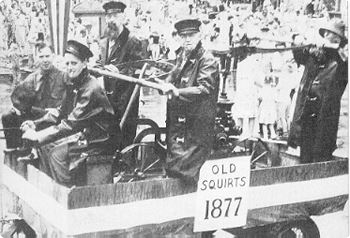
Before the Zeeland Fire department was organized, fires were extinguished by the “Bucket Brigade” method, yet even this method would have proven ineffective against the fires of October 1871.
Holland Fires
High winds and extensive drought conditions caused the disastrous fire in Chicago, the devastating fire in the small Dutch community of Holland and the furnace of fire just southwest of Zeeland. In the Holland fire, 76 business places, 243 homes, 5 churches, 3 hotels, 45 miscellaneous buildings, and 5 warehouses burned. There was a total loss of $900,000.
Preparing for Disaster
For three or four days a strong wind kept the townspeople alert to potential disaster. Many buried their belongings in the ground and prepared to evacuate their homes. It was indeed a blessing to the Zeelanders to have been spared the disaster which befell both Holland and Chicago.
Quote from H. Keppel
“With the dense smoke, heat and wind during the day and flames all over the sky at night, it was indeed a frightful time.” ~ H. Keppel (1866-1918)
Roads
Roads as a New Mode of Transportation
With the designation and clearing of the land came the challenging task of constructing roads, for the initial journeys took place on foot through the dense forest along the Native American trails. One of these trails led through Zeeland from Holland to Grand Rapids.
Hand Axe and Shovel Roads
Corduroy Roads
Within a few years one of the first “corduroy” roads was built. This system was formed by logs laid side-by-side, transversely, covering them with earth and continuing in tiers until the desired height was attained. This work, too, was accomplished almost entirely by hand with the exception of the use of an ox-drawn cart for the bringing of logs to the site. The first highway in the town of Zeeland was constructed in November of 1849. Piles of logs dug up from the old State Street corduroy road may be seen at the Dekker Huis Museum. They range from 6 inches in diameter to 10 inches and were in layers under the roadway.
Easier Travel
As the road system became more complete it was easier for early settlers to travel to villages to attend church, to visit with relatives and friends, and to shop for food and supplies. Zeeland became an important destination for the purchase of needed commodities.
Transportation

Beginning Source of Transportation
Water was the primary means of transportation for the early pioneers during their first two summers in the Zeeland Colony. Provisions and household goods were shipped by flat boats from Holland and other surrounding towns. Teams of oxen were soon employed for distribution of these goods throughout the small colony and were considered to be of great importance by the colonists.
Ox Teams & Wagons
Ox teams and wagons later traveled over the crude road which had been built along the Native American trail, allowing a trip to and from Grand Rapids to be made in approximately four days. The first horses were introduced into the colony in the year 1855.
Railroad Construction
In 1897, with the steady advancement of transportation, the construction of rails for the streetcar and the interurban became more than just a dream. By October of 1901, the tracks had been laid through Zeeland and the first regular service to Grand Rapids had begun.
Moving to Automobiles
With the growing number and improved quality of the roads, the automobile quickly became the more desired means of transportation. John Veneklasen, part owner of the Zeeland and Hamilton Brick Yards, was the first Zeelander to own a private car – with many others to follow.
Retiring the Interurban
With the increasing popularity of the automobile, a new era was introduced. After 25 years, the interurban had been rendered obsolete. In November of 1926, the interurban bell was silenced and the rumble of its wheels was stilled.
Zeeland Hotel
First Hotel
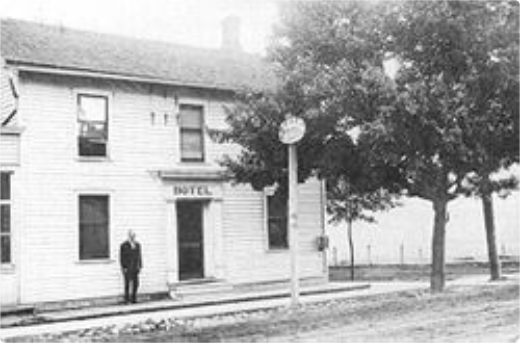
In the early immigration year of 1849, the first — and only — hotel began operation in Zeeland. With the arrival of the steam railroad in 1872, most businesses moved from Cross Street (Central Avenue) to North Street (Main) in order to take advantage of the greater influx to the community. The Zeeland Hotel was no exception and was soon moved to the northwest corner of North Street and Elm.
Main Occupants
The rooms were often occupied by salesmen, crews of linemen who would arrive to make repairs in the area, as well as numerous “regulars”.
Transition to Boarding House
As the hotel once more changed hands in 1922, business was then conducted as a boarding house and hotel. Eventually the building changed to a boarding house alone.
Selling the Zeeland Hotel
By the year 1955 the Zeeland Hotel had served its purpose and was sold to the Zeeland State Bank. The wood frame building was later demolished, and the site became a parking lot for First Michigan Bank and Trust Company.